


Financing a Roofing Company Starts With Matching Funds to the Cash Gap
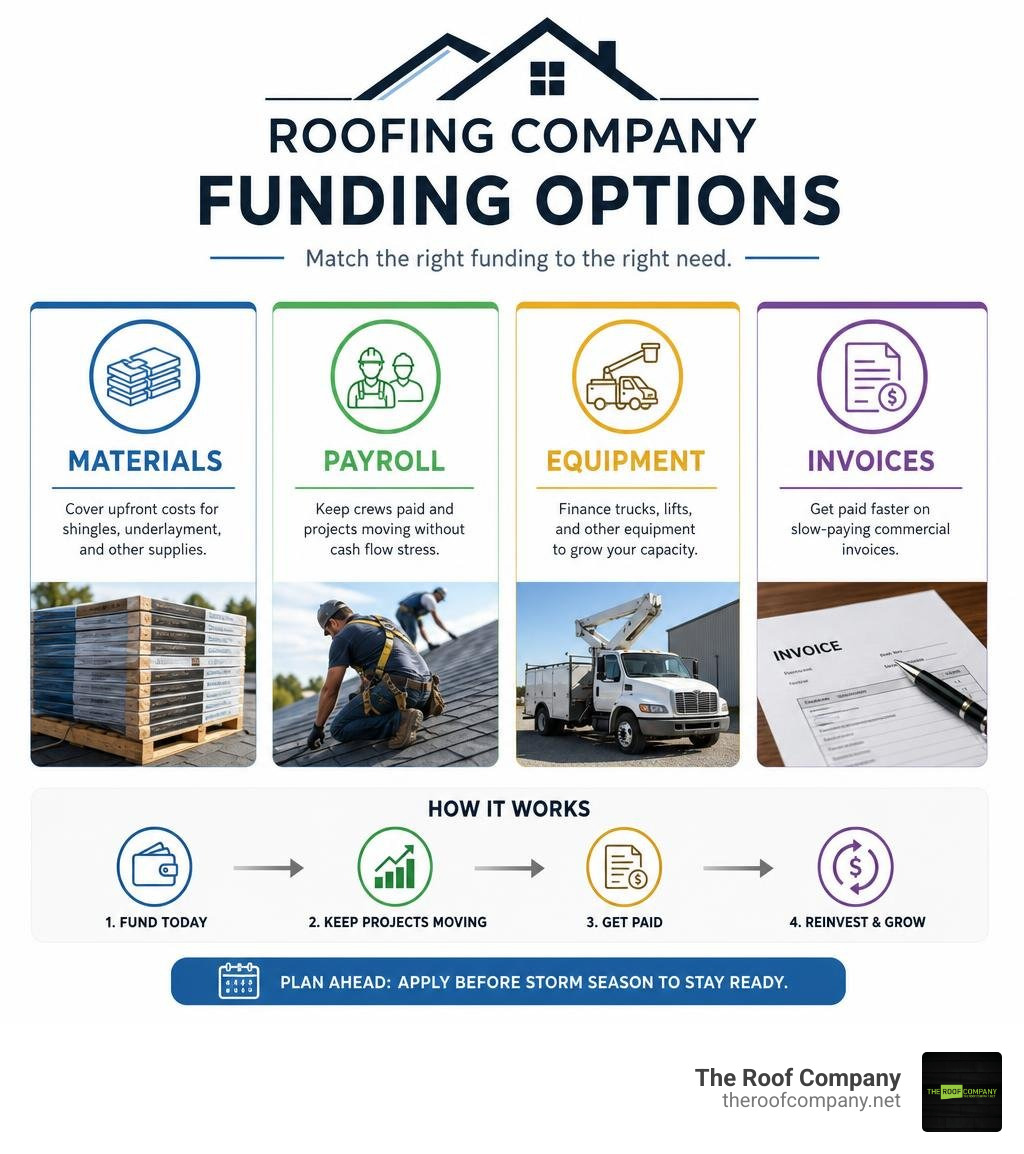
The best approach to financing a roofing company is to match the funding type to the expense. Use working capital or a business line of credit for materials and payroll, equipment financing for trucks and lifts, and invoice factoring for slow-paying commercial invoices. Apply before storm season when possible, and borrow only enough to cover the gap until expected payments arrive.
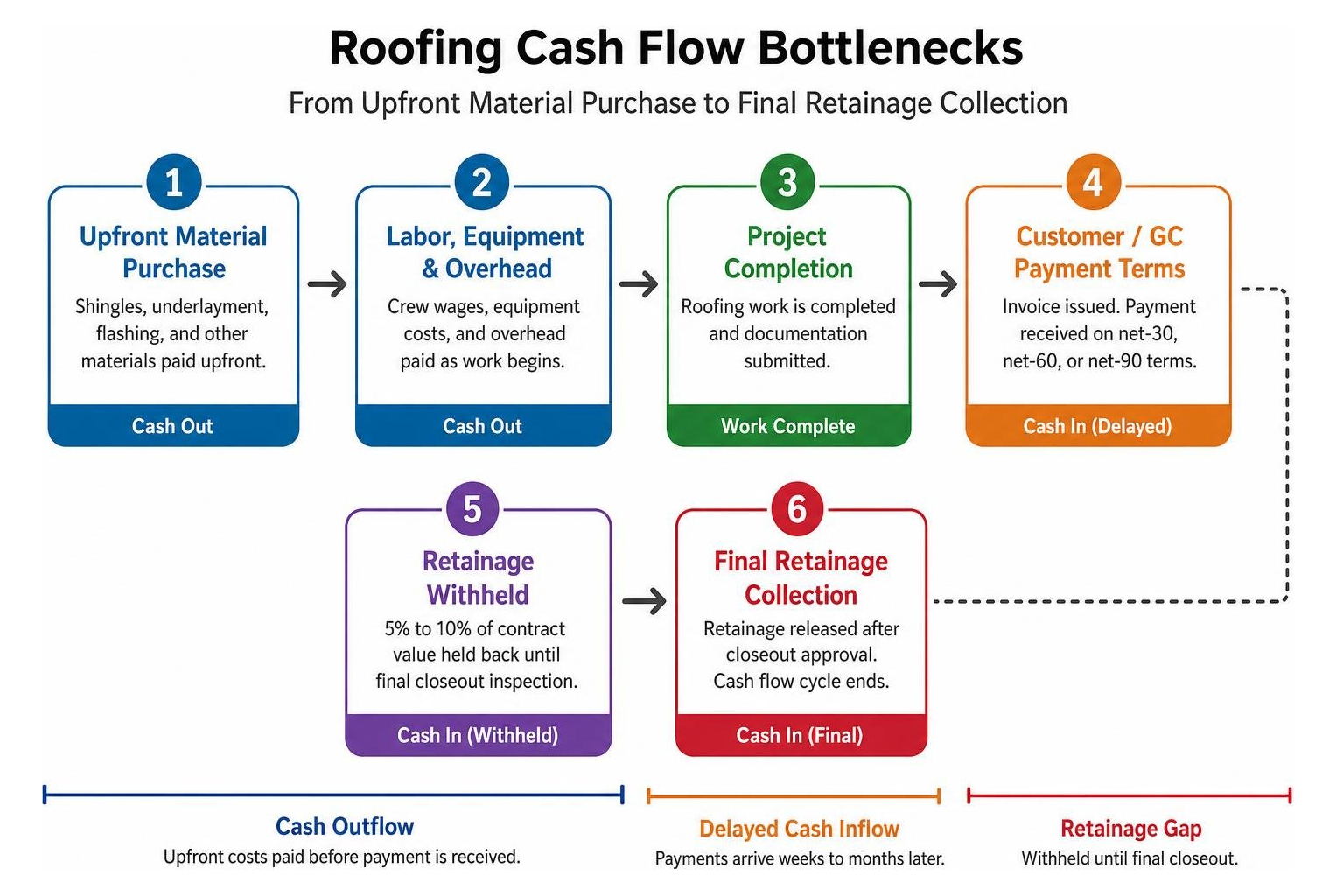
Roofing work can be profitable and still leave a contractor short on cash. Shingles, underlayment, flashing, labor, and equipment costs come first. Customer, general contractor, and insurance payments may arrive weeks later. A residential reroof can require thousands of dollars in materials upfront, while commercial jobs can tie up far more and may hold back 5% to 10% as retainage until closeout.
Storms make this challenge sharper. A sudden hail event can create a full pipeline overnight, but more jobs also mean more crews, more material orders, and more cash leaving the business before insurance claim payments clear. In northern markets, seasonal slowdowns add another pressure: fixed costs continue even when winter revenue drops.
I am Darren, co-owner of The Roof Company, with more than 30 years in the roofing industry. My experience with financing roofing company operations comes from seeing how material costs, weather, and payment timing affect the ability to serve homeowners reliably.
Understanding the Unique Cash Flow Bottlenecks in the Roofing Industry
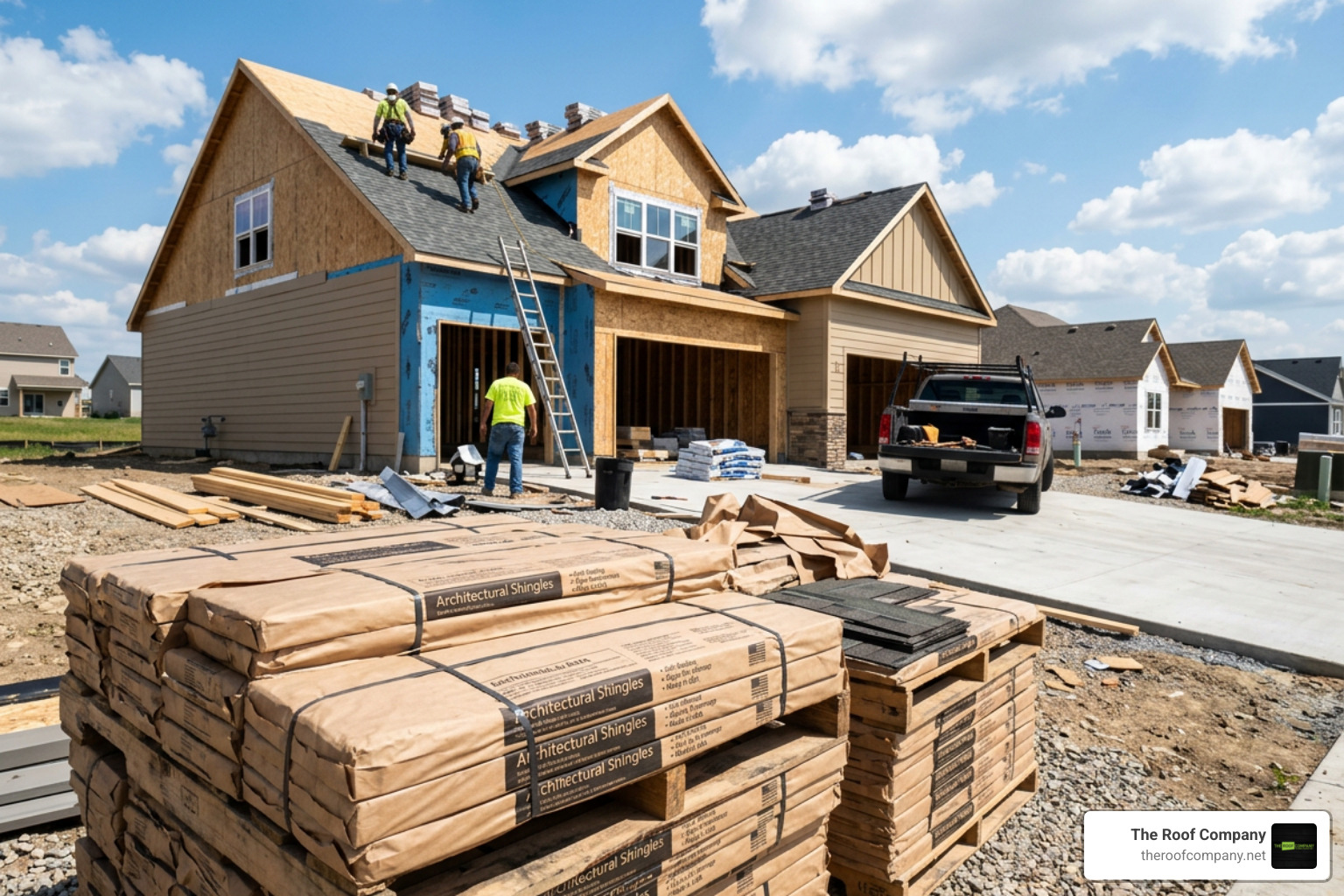
The roofing trade holds a unique position in the construction sector. Across the United States, the roofing industry generates over $56 billion in annual revenue and employs more than 220,000 workers across roughly 100,000 contracting businesses. Interestingly, approximately 80% of these enterprises operate as small businesses with fewer than 10 employees. While demand for reliable shelter is universal, keeping liquid cash on hand is one of the steepest uphill battles an owner faces.
Unlike service trades where technicians arrive with small inventory items in a van, roofers must front tremendous capital just to mobilize. A single residential tear-off and replacement often requires $3,000 to $8,000 in shingles, synthetic underlayment, ice and water shield, and metal flashing before a ladder touches the gutter. For larger commercial flat roofs involving TPO, polyiso insulation boards, and heavy adhesives, material costs regularly climb from $25,000 to $80,000.
When suppliers switch accounts to Cash on Delivery (COD) terms after minor billing delays, contractors must produce liquid funds instantly. Homeowners often ask What Should I Expect To Pay For A Roof Replacement when planning home upgrades, but behind the scenes, contractors are managing massive supplier invoices to keep those installations moving smoothly.
Compounding this pressure are standard commercial terms. Commercial property managers and general contractors routinely operate on net-30, net-60, or even net-90 payment terms. To make matters tighter, they commonly withhold 5% to 10% of the entire contract value as retainage until final closeout inspections pass. That retainage frequently represents the roofing company’s entire net profit on the project.
In northern regions—including our service communities across Novi, South Lyon, Oakland County, Livingston County, Washtenaw County, Macomb County, and Wayne County—seasonality adds a major hurdle. Northern contractors typically generate 70% to 80% of their total annual revenue during the warmer months between April and October. Yet, an established contractor generating $1.5 million in peak-season work still carries $25,000 to $40,000 per month in unavoidable fixed overhead through the freezing winter—covering facility leases, commercial liability insurance, truck payments, and core staff salaries with minimal incoming cash flow.
The Insurance Claim Timing Gap: ACV, Depreciation, and Supplements
Insurance restoration work presents a distinct structural cash gap. When severe weather damages a home, the insurance settlement rarely arrives in a single, timely payment. Instead, carriers issue an initial Actual Cash Value (ACV) check based on the depreciated value of the damaged roof. The remaining balance—the recoverable depreciation (RCV)—is withheld until the contractor finishes the installation, submits itemized certificate-of-completion documentation, and waits for carrier processing.
This split creates substantial delays:
- The Depreciation Lag: The gap between completing the roof and receiving the recoverable depreciation check frequently stretches across 30 to 90 days.
- Mortgage Endorsement Hurdles: Insurance claim checks usually name both the property owner and their mortgage lender. Getting a multi-party check processed, mailed, inspected, and endorsed by an out-of-state bank adds weeks of dead time.
- Supplement Reviews: When hidden structural rotted decking or localized code-upgrade requirements appear mid-tear-off, contractors must file insurance supplements. Carriers can take 60 days or more simply to review and approve these supplements, forcing the roofer to float thousands of dollars in emergency labor and materials to protect the exposed home.
Navigating this reality requires specialized strategies, as detailed in guides like Roofing Financing — Crews, Materials & the Insurance Lag, ensuring crews are compensated while waiting on administrative adjuster approvals.
Storm Season Surge and Operational Scaling Pressures
When severe hail and gale-force wind systems sweep across Southeastern Michigan, incoming customer calls spike in hours. A roofing contractor might see their active pipeline surge from 5 standard replacements to 30 concurrent storm-restoration projects.
While this sudden volume represents massive top-line potential, it is an intense cash trap. Managing a 30-job storm restoration pipeline requires deploying between $120,000 and $450,000 in raw material orders, disposal dumpsters, and crew payroll weeks before insurance proceeds materialize. Property owners assessing local market variables via Roofing Cost Michigan rely on contractors having the immediate purchasing power to secure premium shingles and mobilize trained labor without delay. Without adequate capital reserves, a roofing company can easily run out of cash during its most profitable operational window.
Smart Options for Financing Roofing Company Growth and Operations
According to the Federal Reserve’s Small Business Credit Survey, the most common reason trade firms seek capital is simply to cover everyday operating expenses, with roughly half of all applicants failing to receive the total funding they requested from traditional institutions. Navigating the commercial lending landscape requires choosing the right capital instrument for your business model.
| Financing Solution | Best For | Typical Funding Amount | Funding Speed | Primary Collateral |
|---|---|---|---|---|
| Business Line of Credit | Seasonal lulls, payroll buffers, recurring materials | $20,000 – $250,000 | 1 – 3 Business Days | Unsecured / Business Assets |
| Working Capital Loans | Storm mobilization, bulk material discounts | $10,000 – $500,000 | 24 – 48 Hours | Future Bank Receivables |
| Equipment Financing | Work trucks, dump trailers, shingle hoists | $15,000 – $1,000,000+ | 3 – 7 Business Days | The Purchased Equipment |
| Invoice Factoring | Bridging Net-60/90 commercial GC retainage | 70% – 90% of Invoice Value | 24 – 48 Hours | Commercial Invoices |
| SBA 7(a) / Term Loans | Long-term expansion, facility acquisition | $50,000 – $5,000,000 | 2 – 6 Weeks | Real Estate / Major Assets |
As highlighted by industry resources like Roofing Contractor Business Loans | Roofing Company Financing, pairing specific cash flow crunches with dedicated commercial financial products prevents business owners from over-leveraging their working balances.
Working Capital and Lines of Credit for Financing Roofing Company Needs
Revolving business lines of credit and short-term working capital loans provide flexible liquidity for everyday operations. Rather than taking out a fixed lump sum with immediate amortization, a revolving credit line allows a contractor to draw funds, purchase pallets of shingles, settle weekly subcontractor labor, and repay the balance once customer checks clear—paying interest solely on the capital drawn.
This flexibility is essential for maintaining smooth operations throughout the year:
- Spring Mobilization: Drawing funds in March or April to restock inventory, service vehicle fleets, and launch marketing efforts before the busy season begins.
- Off-Season Bridge: Drawing funds in December or January to maintain key project managers and foremen on full payroll during sub-zero stretches.
- Consumer Payment Flexibility: Helping contractors maintain working stability while educating clients on personal project options like How Do You Pay For A New Roof Your Ultimate Financing Guide.
Equipment Financing, Fleet Expansion, and Section 179 Deductions
Roofing operations depend heavily on vehicles and machinery. Equipping a full crew with a reliable heavy-duty work truck, high-side hydraulic dump trailer, pneumatic nail guns, air compressors, and safety equipment can run between $70,000 and $125,000.
Equipment financing packages use the underlying vehicle or machine as direct collateral. This structure keeps interest rates relatively low (typically 6% to 14% APR) and protects your primary bank liquidity.
Furthermore, under Section 179 of the Internal Revenue Code and current bonus depreciation guidelines, roofing companies can often deduct up to 100% of the qualifying equipment purchase price in the first tax year. For example, purchasing a $215,000 crane truck or conveyor vehicle with 10% down ($21,500) can yield substantial year-one tax savings that exceed the initial cash down payment.
Invoice Factoring and Commercial Receivables
For contractors handling multi-family properties, retail plazas, or industrial flat roofs, invoice factoring solves the long wait for payment. Instead of waiting 60 to 90 days for a commercial property management firm to disburse progress draws or release withheld retainage, a factoring partner advances 70% to 90% of the verified invoice value within 24 to 48 hours. The factoring company collects the final invoice amount directly from the customer, returning the remaining reserve to the roofer minus a small transaction fee (typically 1.5% to 4%).
How Lenders Evaluate Roofing Contractors Differently than Traditional Banks
Traditional commercial banks often struggle to understand the realities of running a roofing business. Conventional loan officers look for steady, predictable monthly deposits and extensive real estate collateral. When a bank underwriter reviews a northern contractor’s balance sheet and sees high revenue in July followed by low income in January, they often classify the business as volatile. Similarly, banks frequently misunderstand subcontracted labor models and delayed insurance receivables.
Specialized B2B lenders evaluate roofing companies through bank-statement underwriting. Instead of getting bogged down in historical tax write-offs or winter slowdowns, specialized commercial underwriters review trailing 12-month bank statements to assess your broader annual cash trends. Approvals are typically sized based on 10% to 15% of annual gross revenue, or 50% to 150% of an average active month’s bank deposits.
Educating property owners through transparent cost breakdowns, such as What Does A New Roof Cost In Michigan Average Prices And Calculator Tips, helps contractors maintain steady contract pipelines that make qualifying for business capital much easier.
Overcoming Bad Credit When Financing Roofing Company Expansion
Past personal credit bumps or seasonal cash dips do not automatically shut the door on business growth. Modern revenue-based financing focuses primarily on verified monthly cash flow rather than personal credit scores.
Contractors with personal FICO scores in the 500 to 600 range can often qualify for working capital lines if their business generates steady monthly bank deposits ($10,000 to $25,000+ minimum) and shows at least six months of continuous operations. Repayment is frequently handled via automated ACH remittances that flex naturally with incoming revenue. Additionally, initial pre-qualification relies on soft credit pulls that do not impact your credit score.
By maintaining clear operational practices and providing homeowners with options for Affordable Roof Replacement Michigan, roofing businesses can maintain the predictable deposit volume that alternative commercial lenders look for.
Required Documentation and Fast-Track Approval Timelines
Applying for alternative working capital or equipment financing is fast and straightforward compared to the months-long process of conventional bank loans.
To secure fast approvals within 24 to 48 hours, contractors should have the following documents ready:
- 3 to 4 consecutive months of complete business checking account statements
- A legible copy of a valid government-issued photo ID (Driver’s License or Passport)
- A voided company check matching the operating entity
- Basic business formation paperwork (Articles of Incorporation or LLC documentation)
- An equipment invoice or dealer spec quote (if applying for machinery or fleet financing)
Frequently Asked Questions About Roofing Business Financing
How fast can a roofing contractor get funded during peak storm season?
Working capital loans and merchant lines of credit can fund in 24 to 48 hours once bank verification is complete. Equipment financing packages typically take 3 to 7 business days for dealer coordination, while larger SBA 7(a) government-backed loans generally require 2 to 6 weeks for full closing.
Can a roofing company qualify for business loans despite winter revenue slowdowns?
Yes. Specialized trade lenders evaluate 12-month trailing gross bank deposits rather than judging a business solely on low off-season winter volume. Showing a consistent history of strong spring and summer earnings demonstrates the ability to manage winter overhead. For residential customers wondering how to manage unexpected winter leaks safely, resources like No Cash Up High How To Finance A New Roof Safely offer clear guidance on manageable payment plans.
What is the difference between working capital loans and invoice factoring for roofers?
Working capital loans provide immediate liquidity based on overall monthly business revenue and are repaid over fixed or revenue-based terms via ACH. Invoice factoring specifically advances capital against completed, uncollected commercial invoices or delayed retainage balances, with the factoring company collecting directly from the commercial client.
Conclusion
Managing a successful roofing business requires balancing technical installation expertise with proactive cash flow management. The gap between purchasing materials upfront, paying skilled crews every Friday, and waiting for slow insurance checks or commercial retainage can strain even the most profitable operations.
By matching your specific cash needs with the right commercial financing options—whether through flexible working capital, revolving credit lines, or equipment loans—roofing contractors can confidently scale their businesses through storm seasons and winter slowdowns alike.
At The Roof Company, we believe in straightforward communication, quality craftsmanship, and reliable service across Southeastern Michigan. Whether you are a homeowner planning your next exterior project or seeking flexible payment options, explore our convenient commercial and residential financing solutions to discover how we deliver lasting peace of mind under every roof.


