


What You Need to Know About Roof Replacement
Roof replacement is one of the biggest home improvement projects you’ll ever face — and one of the most important.
Here’s a quick summary before we dive in:
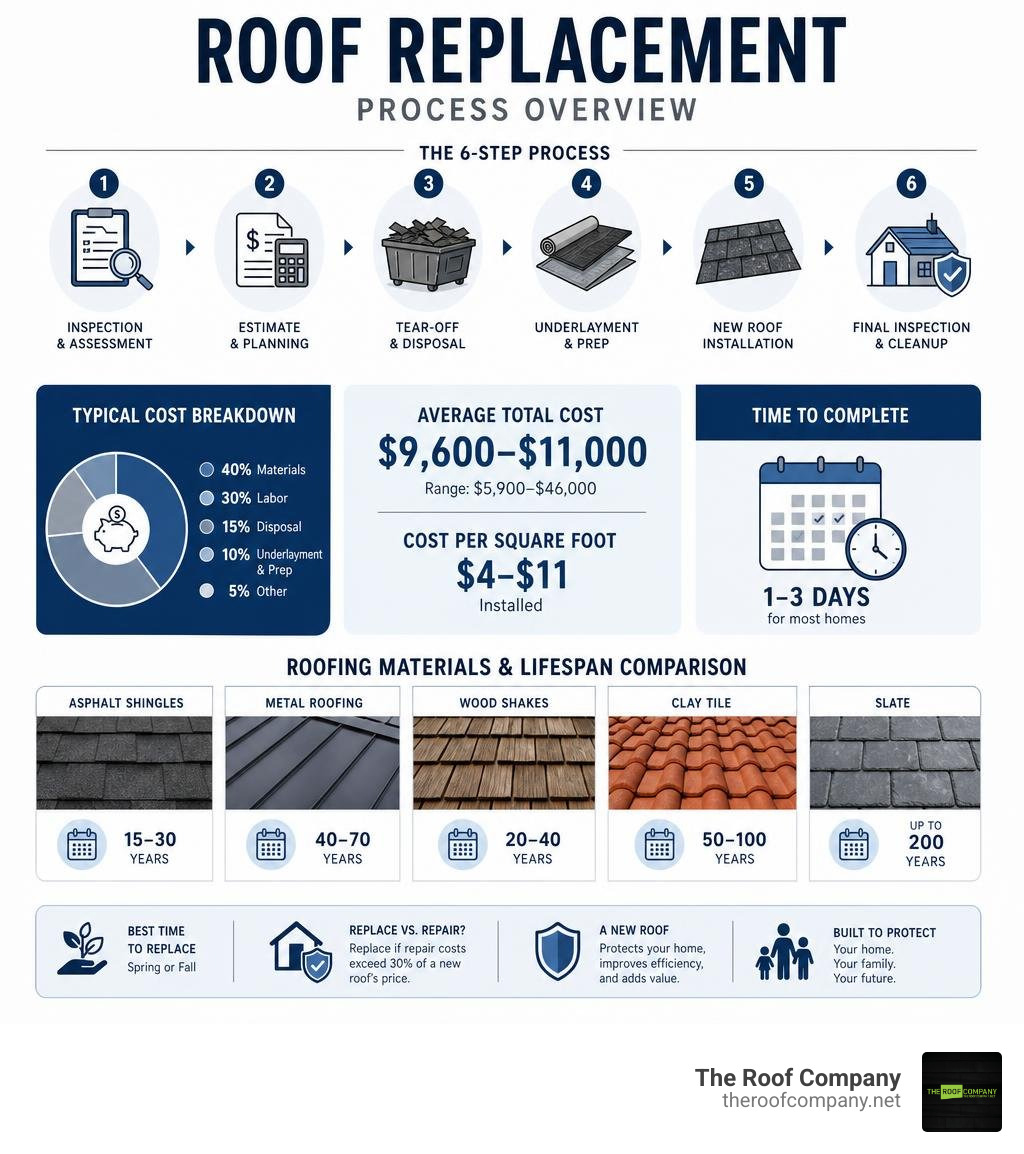
| Question | Quick Answer |
|---|---|
| Average cost | $9,600–$11,000 (range: $5,900–$46,000) |
| Cost per square foot | $4–$11 installed |
| Most common material | Asphalt shingles (15–30 year lifespan) |
| Longest-lasting material | Slate (up to 200 years) |
| Time to complete | 1–3 days for most homes |
| Best time to replace | Spring or fall |
| Replace vs. repair? | Replace if repair costs exceed 30% of a new roof’s price |
A failing roof doesn’t just mean leaks. It means damaged ceilings, higher energy bills, and a home that’s slowly losing value. The longer you wait, the more it costs.
Most homeowners don’t think about their roof until something goes wrong. A missing shingle here, a water stain there — and suddenly you’re facing a repair bill that keeps growing. At some point, patching the same problems over and over stops making financial sense.
That’s exactly why this guide exists. Whether you’re seeing early warning signs or already dealing with serious damage, we’ll walk you through everything — costs, materials, timing, and how to find a contractor you can actually trust.
I’m Darren Youngquist, co-owner of The Roof Company, and with over 30 years of hands-on experience in roof replacement across Southeast Michigan, I’ve helped thousands of homeowners navigate this exact process. Let’s break it all down so you can make a confident, informed decision.
Repair vs. Replacement: How to Decide
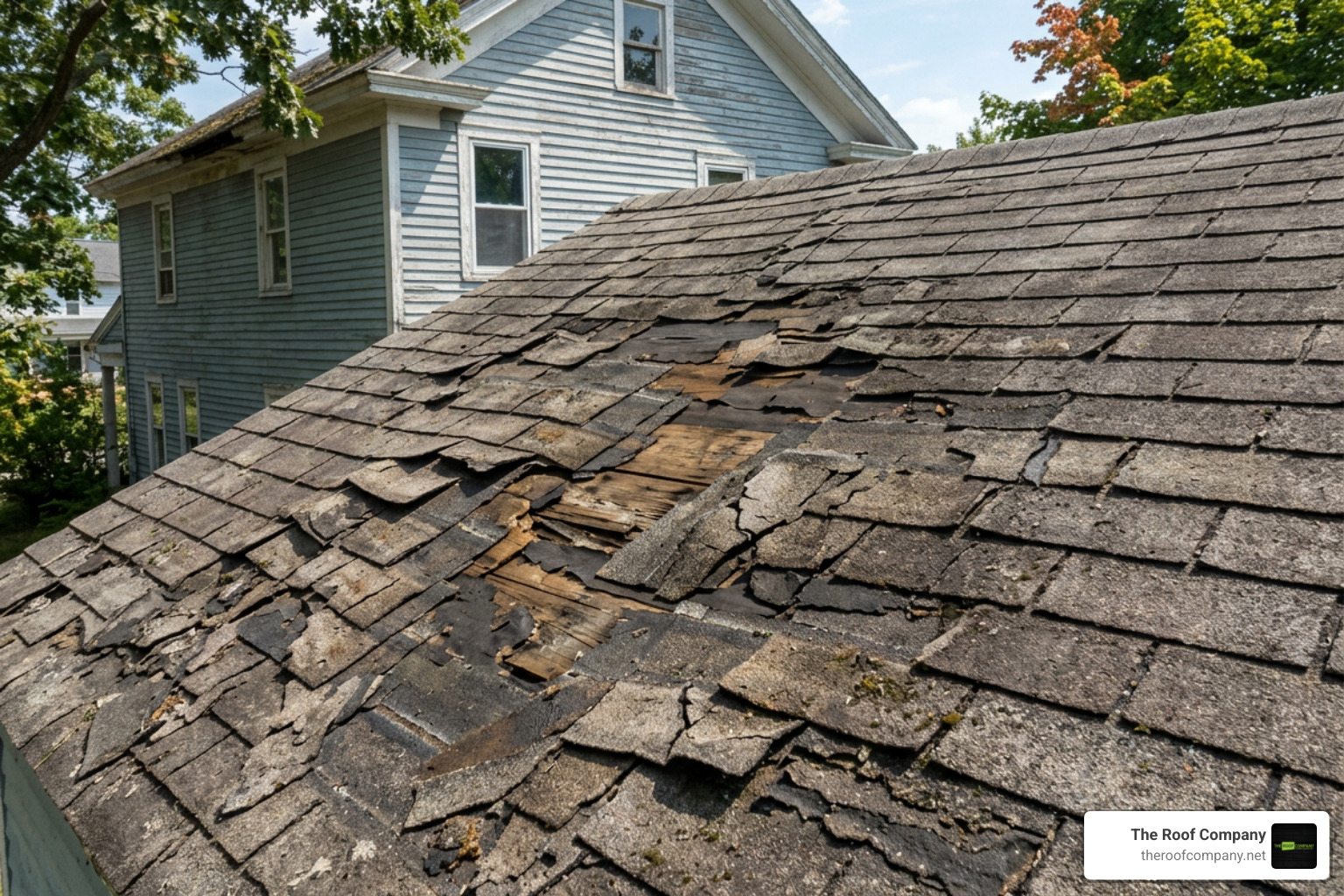
It is the age-old homeowner’s dilemma: Do you patch up the leak and hope for the best, or do you bite the bullet and invest in a brand-new roof?
Every month, we meet homeowners in South Lyon, Novi, and throughout Oakland County who are trying to stretch their current roof just one more year. We completely understand why. A full roof replacement is a major financial decision, while a repair feels like a quick, budget-friendly fix. However, continuing to patch an aging roof often leads to compounding costs that quickly exceed the price of a new installation.
To make the right choice, you need to understand the physical warning signs your roof is giving you and apply a simple financial rule of thumb. If you are struggling with a persistent leak right now, you can learn more about our targeted solutions by visiting our roof repair services page.
Signs It Is Time for a Roof Replacement
Your roof is your home’s primary shield against Michigan’s unpredictable weather—from heavy winter snows to severe summer thunderstorms. While some issues can be resolved with a quick repair, several clear indicators suggest your roof is nearing the end of its useful life:
- Curling, Buckling, or Cupping Shingles: When shingles age, they lose their flexibility. If the edges of your shingles are curling upward or the centers are bubbling, they can no longer shed water properly or resist wind uplift.
- Widespread Granule Loss: Check your gutters. If you find piles of colored sand inside them, your shingles are losing their protective asphalt granules. Without this outer layer, the sun’s UV rays will quickly bake and crack the underlying asphalt.
- Missing Shingles: While replacing one or two shingles lost in a windstorm is a standard repair, losing entire sections of shingles means the adhesive sealant has failed across the entire system.
- A Sagging Roof Deck: If you notice a droop or sag along the ridge line or in the flat sections of your roof, this is a structural emergency. It typically indicates long-term water damage has rotted the underlying wood decking.
- Daylight in the Attic: If you climb into your attic on a sunny day, turn off the lights, and see beams of daylight peeking through the roof boards, water is definitely getting in too.
- Recurring Water Stains and Leaks: A single leak after a massive storm is a repair job. Multiple active leaks across different rooms mean the entire system is failing.
- The Age of the Roof: If your asphalt shingle roof is approaching or has exceeded 20 to 25 years of age, its materials are naturally reaching the end of their chemical lifespan. Even if it looks fine from the ground, the clock is ticking.
The 30% Rule for Repairs
When you are on the fence between repairing and replacing, we recommend using the 30% Rule.
If the cost of repairing your current roof exceeds 30% of the price of a complete roof replacement, replacement is almost always the smarter, more cost-effective choice.
For example, if a reputable contractor quotes you $3,500 to fix several valleys and replace flashing on a roof that would cost $10,000 to replace entirely, you are better off investing that money directly into the new roof. Why? Because spending thousands of dollars to patch up a system that is already 18 years old does not stop the surrounding shingles from failing next month. You are simply throwing good money after bad.
Choosing a full replacement gives you a clean slate, protects your home’s structural integrity, and grants you the peace of mind that comes with modern manufacturer warranties.
Key Factors That Influence Roof Replacement Cost

When you start gathering quotes for a roof replacement, you might notice that prices vary significantly. This is because no two roofs are identical. A price estimate is not a random number pulled out of thin air; it is calculated using several highly specific physical and material variables.
To get a comprehensive look at how these numbers are structured nationally, check out the How Much Does It Cost for a Roof Replacement? Complete 2026 Price Guide – Geometry of Molecules. Locally, professional roof replacement costs $9,601 on average, with overall prices ranging from $5,900 to $46,000 depending on your home’s size, material choice, and architectural design.
Roof Size, Pitch, and Complexity
The physical blueprint of your home is the primary starting point for any quote. Roofers measure projects in “squares,” where one roofing square equals 100 square feet of roof surface.
- Square Footage: The average American home has a roof surface size between 1,300 and 1,800 square feet (13 to 18 squares). Naturally, the larger the footprint of your home, the more materials and labor will be required. That due to overhangs and slopes, your roof’s surface area is always 1.2 to 1.8 times larger than your home’s ground-floor footprint.
- Roof Pitch (Slope): Pitch refers to how steep your roof is. A flat or low-slope roof is easy to walk on, making installation faster and safer. A steep roof (typically any slope greater than a 6:12 pitch) requires specialized safety harnesses, scaffolding, and slower, more deliberate labor. A steep pitch can easily add $1,000 to $3,000 in extra labor costs.
- Complexity: A simple gable roof with two flat slopes is highly cost-effective and quick to install. However, if your roof features multiple valleys, dormers, skylights, chimneys, or intersecting roof lines, the labor costs rise. Each of these features requires custom flashing, meticulous underlayment work, and extra cutting of shingles, which increases both material waste and installation time.
Choosing the Right Material for Your Roof Replacement
The material you choose is the single largest variable you can control to adjust the final price of your project. Here is how the most common roofing materials compare in terms of average installed cost (for a standard 2,000-square-foot roof) and expected lifespan:
| Material Type | Average Installed Cost (2,000 sq. ft.) | Average Lifespan | Cost per Year of Service |
|---|---|---|---|
| Asphalt Shingles | $5,800 – $20,000 | 15 – 30 Years | $370 – $500 |
| Metal Roofing | $5,700 – $25,000 | 30 – 100 Years | $340 – $550 |
| Clay/Concrete Tile | $8,500 – $26,400 | 50 – 100 Years | $170 – $260 |
| Slate or High-End Stone | $5,800 – $30,000+ | 75 – 200 Years | $280 – $680 |
While asphalt shingles remain the most popular and budget-friendly choice upfront, materials like metal and tile offer incredible longevity, making them highly economical when you look at their cost-per-year-of-service.
Tear-Off vs. Overlay Decisions
When replacing your roof, you have two physical installation methods to choose from: a complete tear-off or a nail-over (overlay).
A full tear-off involves stripping your existing roof down to the bare wood decking, inspecting the wood for rot, replacing damaged sheets, and installing a completely new roofing system from the deck up.
An overlay involves leaving the old shingles in place and nailing a new layer directly over them. While skipping the tear-off can save you $2,000 to $4,000 in immediate labor and disposal fees, we almost always advise against it for several critical reasons:
- Hidden Damage: An overlay traps existing moisture and hides rotted wood decking underneath. If your deck is soft or rotting, nailing new shingles into it is highly unsafe.
- Weight Limits: Shingles are heavy. Adding a second layer places thousands of pounds of extra stress on your home’s framing. In fact, Michigan building codes strictly limit residential roofs to a maximum of two layers for structural safety.
- Reduced Lifespan: The heat trapped between the two layers of shingles will cause the top layer to bake, curl, and degrade 10% to 20% faster than normal.
- Voided Warranties: Many major shingle manufacturers will reduce or completely void their material warranties if their products are installed over an existing layer of shingles.
Planning, Timing, and Contractor Selection
A successful roof replacement requires careful planning and coordination. From picking the ideal season to vetting the crew working on your home, taking the right steps upfront ensures a smooth, stress-free installation. If you are ready to explore your options with a team that values transparency and convenience, visit our Trusted Roofing Services homepage.
Best Time of Year to Schedule
While roofers work year-round, the season you choose to schedule your project can impact both the installation quality and your wallet.
- Spring and Fall (The Peak Seasons): These are the most popular times for a roof replacement. The mild temperatures (typically between 45°F and 85°F) are ideal for both the crew and the materials. Asphalt shingles require warmth and direct sunlight to activate their self-sealing adhesive strips. If it is too cold, the shingles will not seal properly until warmer weather arrives.
- Summer: Summer is a highly active time, but extreme heat can make shingles soft and easily scuffed during installation. Our crews work early in the morning to beat the heat and protect your materials.
- Late Fall and Winter (The Off-Season): If you are looking to save money, scheduling your project in late fall (October to November) or early spring (March to April) can sometimes secure you off-season discounts of 5% to 15% due to lower demand.
Vetting Your Roofing Contractor
Your roof is only as good as the hands that install it. To protect your home and your investment, you should vet local contractors thoroughly. This is especially true in Southeast Michigan, where local building codes and weather demands require expert knowledge.
When searching for a reputable partner, you should evaluate local experts who understand the unique weather demands of Southeast Michigan. For broader county-level verification, you can explore municipal assistance programs like the Roof Replacement Program | Washtenaw County, MI – Official Website or browse highly-rated teams on THE BEST 10 ROOFING IN MACOMB COUNTY, MI.
Always ask any contractor these essential questions before signing a contract:
- Are you licensed in the state of Michigan, and can you provide your license number?
- Do you carry active workers’ compensation and general liability insurance? (This protects you from liability if a worker is injured on your property).
- Will you perform a complete tear-off down to the bare wood deck?
- Do you handle the building permit process and schedule the final municipal inspection?
- What does your cleanup process look like, and how do you protect my landscaping and driveway?
Understanding Warranties and Insurance
When you invest in a new roof, you want to make sure that investment is protected for decades. That is why you need to understand the two distinct types of warranties:
- Manufacturer Material Warranty: This covers defects in the shingles themselves. Standard asphalt shingle warranties range from 25 to 50 years. As certified installers, we can often offer extended manufacturer warranties that cover the entire integrated roofing system.
- Workmanship Warranty: This is provided directly by your roofing contractor and covers errors made during the installation process. While many local companies offer 2-year to 10-year workmanship coverage, we back our installations with lifetime guarantees because we believe in doing the job right the first time.
What about homeowners insurance? If your roof is damaged by a sudden, covered peril—such as hail, fallen trees, or severe windstorms—your homeowners insurance policy will typically cover the cost of a roof replacement, minus your deductible. However, insurance will not pay for a replacement if your roof is simply old, worn out, or suffering from a lack of regular maintenance.
Additionally, be aware of how your policy is written:
- Replacement Cost Value (RCV): The insurer pays the full cost to replace the roof at today’s market prices.
- Actual Cash Value (ACV): The insurer depreciates the payout based on the age of your roof. If your 20-year-old roof fails, you may only receive a fraction of the cost of a new one.
- Premium Discounts: On the bright side, installing a new roof—especially one utilizing impact-resistant shingles—can often earn you significant discounts on your annual home insurance premiums!
Frequently Asked Questions about Roof Costs
How much does a new roof cost on average in 2026?
In 2026, the national average cost for a professional roof replacement is around $9,601 to $11,000 for a standard 2,000-square-foot home using architectural asphalt shingles. On a square-foot basis, expect to pay between $4 and $11 per square foot installed. The final price depends heavily on your choice of material, the slope of your roof, and local labor rates.
Can I install a new roof over my existing one?
Yes, building codes generally allow for up to two layers of asphalt shingles on a residential roof. However, doing so is rarely a good idea. An overlay prevents your contractor from inspecting the decking for rot, traps extra heat (which shortens the lifespan of your new shingles), adds immense physical weight to your home, and can void manufacturer warranties. A full tear-off is always the best practice.
Does homeowners insurance cover a new roof?
Homeowners insurance covers a roof replacement if the damage is caused by a sudden, accidental event like a major windstorm, hail, or a fallen tree. It does not cover replacements due to general wear and tear, age, mold, or neglect. Always document storm damage immediately with photos and contact a professional roofer to perform a detailed inspection before filing a claim.
Conclusion
A roof replacement is more than just a home maintenance chore; it is an investment in the long-term safety, energy efficiency, and value of your home. While the process can feel overwhelming, working with a partner who prioritizes clear communication, honesty, and high-quality craftsmanship changes everything.
At The Roof Company, we make the entire process convenient and transparent. We back our work with lifetime guarantees so you never have to worry about your roof again. Whether you need a complete roof replacement, a quick repair, a modern gutter replacement, or an energy-saving insulation installation, our team is here to help. We also specialize in supporting property managers with commercial and multi-family roofing needs across Southeast Michigan.
Ready to protect your home with a roof built to last a lifetime? Schedule a professional roof replacement with The Roof Company today for your free, honest estimate!


